Marine sediment sampling work is usually done for sea sand exploration (reclamation),
or undersea mining exploration. According to Bent et al (2001) in Minarto et al (2008)
sediments are defined as particles resulting from weathering of rocks, biological materials,
chemical deposits, dust, plant residues, and leaves. Factors that play a role in
sediment deposition in a waters are the currents and basic shapes of these waters.
The current can give force to the particle of sediment of a certain size and move it.
The movement of sediment particles is hereinafter referred to as sediment transport.
Sediment transport is categorize as bed transport (bedload) and float transport (suspended).
Sediment particle in bed transport can undergo three movements: sliding, rolling, and saltation.
A floating transport mechanism can occur when the basic transport experiences a large force so
that the sediment particles are lifted and turbulent by currents and waves.
The lifting of sediment particles to layers that having a force equal to or greater than
the weight of the sediment, causes the particle to remain suspended. Sedimentation can occur
if the sediment particles lose their driving force.
To identify sediment composition, we can use Grab Sampler.
Grab Sampling mechanism is to lower shaped scraper tool that open like shell, made of
metallic materials, that are bound with a rope at the sampling location.
The scraper will fall to the bottom of the water. When the rope is lifted then the tool
will automatically dredge and lock the taken sediments.
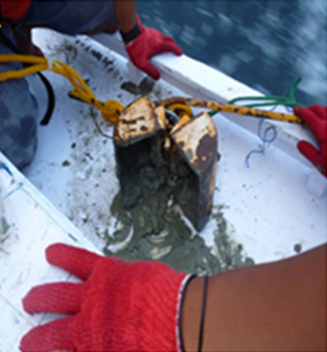
Figure 1. Grab Sampler.
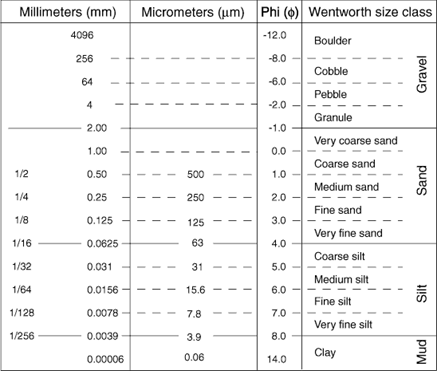
Sample sediment from the field can be classified by Wentworth scale. So we can determine the content of the sediment in the survey area.Table 1. Wenworth Scale (1992).