Seismic Downhole is a method from applied geophysics that uses the principle of seismic waves
propagation in rock bodies/internal layers of the earth. On the ground surface, Seismic waves
are generated usually with a sledge hammer hitting a beam deployed at the ground surface.
Seismic Downhole is a method from applied geophysics that uses the principle of seismic waves
propagation in rock bodies/internal layers of the earth. On the ground surface, Seismic waves
are generated usually with a sledge hammer hitting a beam deployed at the ground surface.
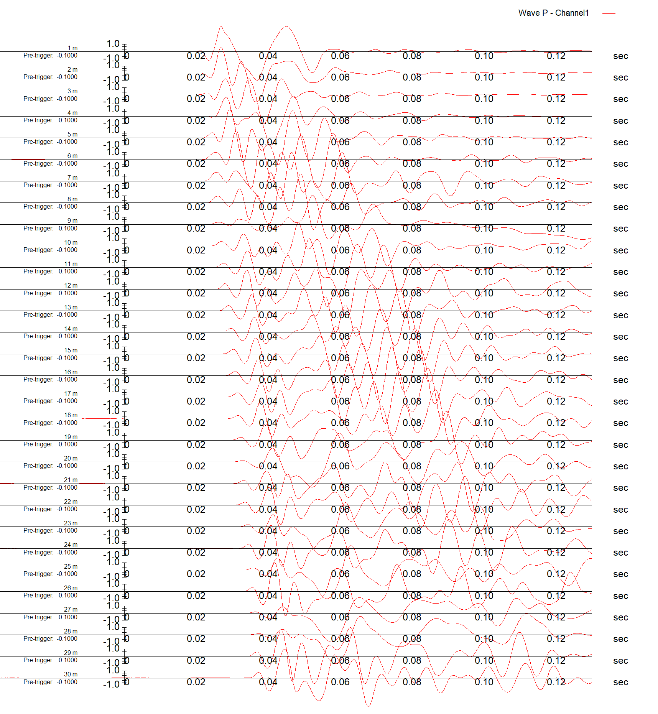
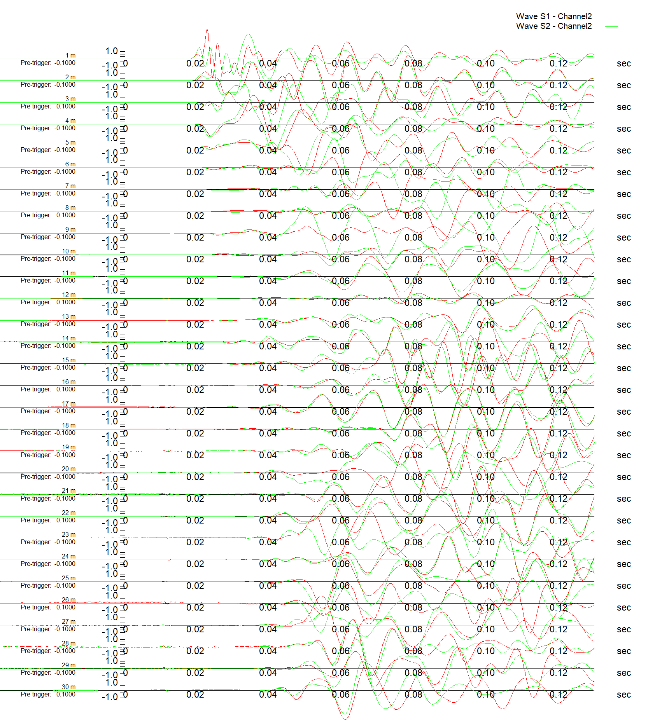
Seismic waves consisting of P wave and S waves that propagate and are then recorded by
geophones that have been placed in the borehole. Downhole seismic method measures the time
taken for seismic waves (P wave and S waves) to move between a seismic source located on the
surface of the ground, and the receivers, placed inside a borehole
Downhole seismic method measures the time taken for seismic waves (P wave and S waves)
to move between a seismic source located on the surface of the ground, and the receivers,
placed inside a borehole.

Main objective Downhole Seismic is used to obtain elastic modulus information from the
subsurface medium through the seismic wave velocity, P wave velocity (Vp) and S Wave
velocity (Vs) in the subsurface medium.

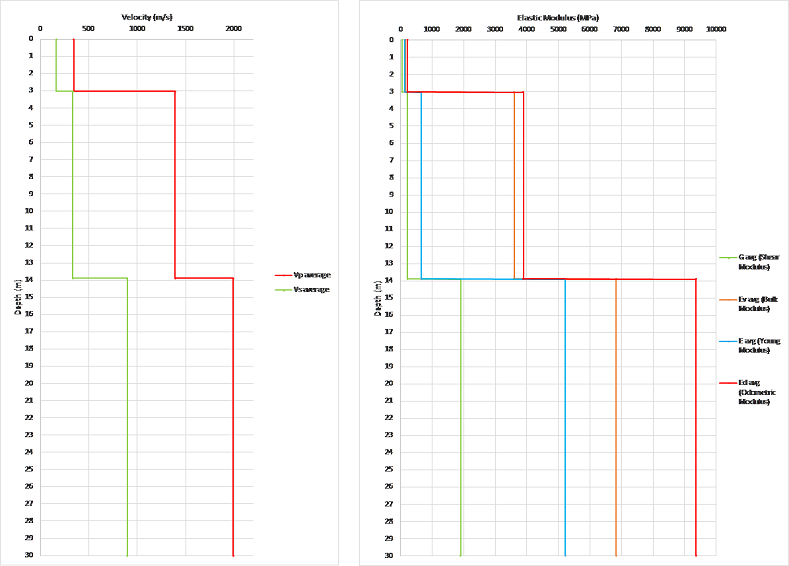 Based on the Vp and Vs data obtained from the Seismic Down Hole test and density (?)
from bore hole coring, it can be estimated the near-surface soil geotechnical properties.
Based on the Vp and Vs data obtained from the Seismic Down Hole test and density (?)
from bore hole coring, it can be estimated the near-surface soil geotechnical properties.
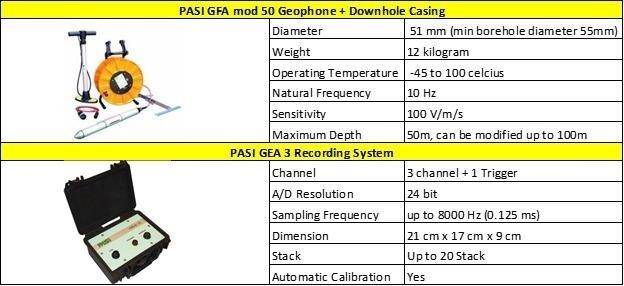
The instrument used in seismic downhole survey work is PASI GFA 50 with PASI GEA 3 Recording System.
GFA 50/100 3D borehole geophone is realized with 3x high sensitive geophones natural frequency 10Hz,
1 vertical and 2 horizontal sensors, oriented according to a triad of orthogonal Cartesian axes (XYZ).