
Ocean Current Survey is using ADCP and Direct Reading Current Meter.
The placement of sea current measurement positions should consider ease of access,
observation process, and be at a depth of more than 15 meters. Position of Current meter
can be determined by handheld GPS. The reading of ocean currents should be carried out
continuously for every 60 minutes, and the observation time should be the same as the
tidal observation time. Sea Current Survey can be done with two kinds of tool that is ADCP
(Automatic Doppler Current Profiler) or Direct Reading Current Meter.
ADCP (Automatic Doppler Current Profiler) is a device that can measure the velocity
and direction of current at various depths at once by using Doppler technology.
In ADCP there is a data logger that records the data velocity and current direction
at various depths that are required automatically for several days in each hour.
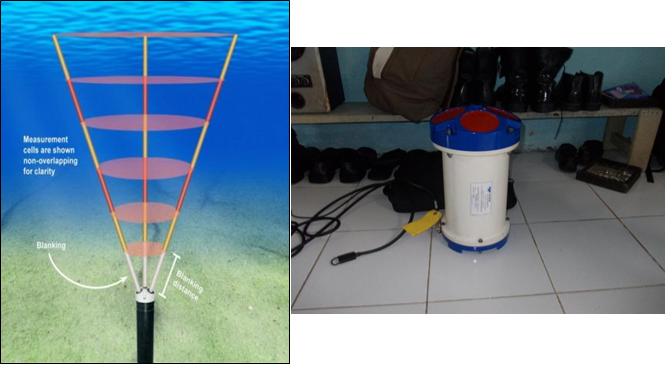
Figure 1. ADCP and measurement cells.
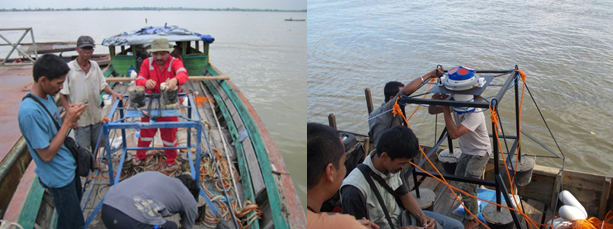
Figure 2. ADCP Installation.
In addition to using ADCP, sea current measurements can also use “Direct Reading Current Meter”. The disadvantages of the measurement using the Current meter is the need for the operator to check for current condition every one hour manually.
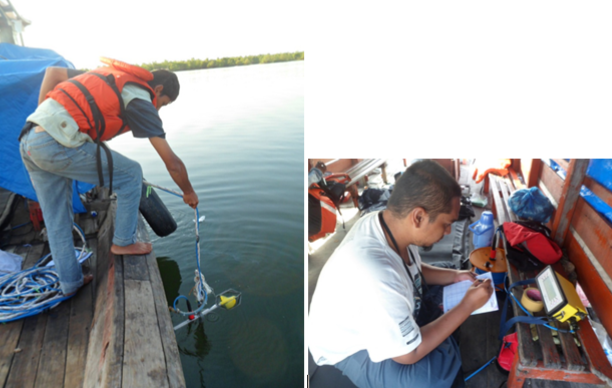
Figure 3. Direct Reading Current Meter.
Result of observation of sea currents, can be plotted in the form of direction and magnitude of current value, plots result of current data can be seen in the following figure:
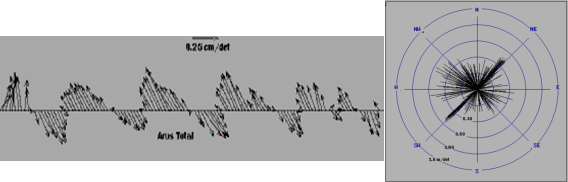
Figure 4. Total Current.
The total current consists of currents caused by tidal currents and non-tidal currents. Tidal currents can be identified by a rotating current pattern. The non-tidal current is the residual current of the total current reduced by the tidal current. Non-tidal currents can be caused by meteorology, geography, geology, etc. But usually non-tidal currents are most influenced by currents caused by meteorological effects (wind and weather). Figure below shows tidal current and non-tidal current of total current from figure above.
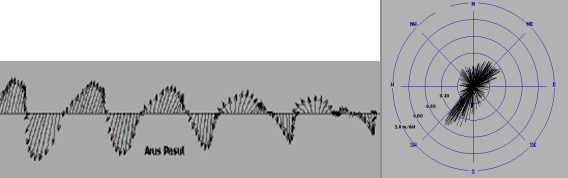
Figure 5. Tidal Currents.
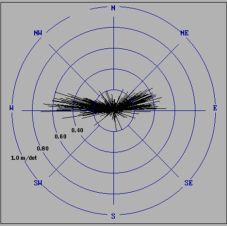
Figure 6. Non-Tidal Currents.