
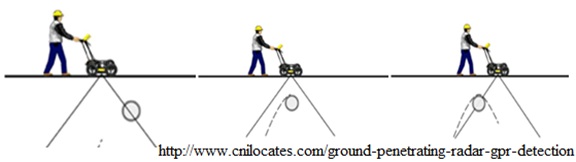
 GPR method is a geophysical method that utilizes electromagnetic waves (EM) in response to
the reflectivity properties (reflectance) of a material. The EM waves emitted from a radar transmitter,
through an interface (boundary) between two mediums (rock, concrete, water, metal, etc.) have
different values of physical properties. Then the EM wave is reflected back and recorded by the receiver
as a subsurface picture signal and can be observed directly on the display monitor of the Digital Control Unit.
GPR method is a geophysical method that utilizes electromagnetic waves (EM) in response to
the reflectivity properties (reflectance) of a material. The EM waves emitted from a radar transmitter,
through an interface (boundary) between two mediums (rock, concrete, water, metal, etc.) have
different values of physical properties. Then the EM wave is reflected back and recorded by the receiver
as a subsurface picture signal and can be observed directly on the display monitor of the Digital Control Unit.
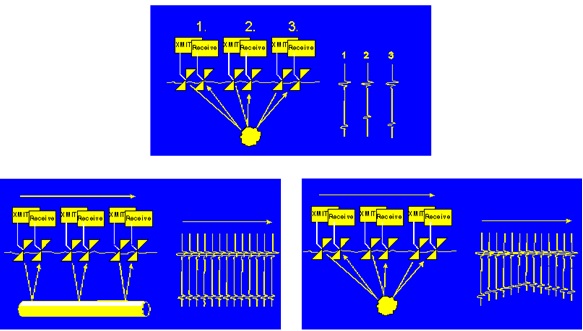 GPR works using two antennas which consist of the transmitter antenna and the receiver antenna.
The Transmitting antenna (transmitter) emits pulses of radar waves into the ground.
Suppose there is an object such as a pipe, cable, or other object that have different dielectric properties of
the surrounding area below the surface. In that case, this object will reflect radar pulses to the surface
which is then received by the receiving antenna (receiver). Both antennas are located on the same console or
separately, depending on the type of antenna that is related to the penetration depth of the target.
The figure below shows how the working principle of the GPR tool to obtain anomalous objects in the ground.
GPR works using two antennas which consist of the transmitter antenna and the receiver antenna.
The Transmitting antenna (transmitter) emits pulses of radar waves into the ground.
Suppose there is an object such as a pipe, cable, or other object that have different dielectric properties of
the surrounding area below the surface. In that case, this object will reflect radar pulses to the surface
which is then received by the receiving antenna (receiver). Both antennas are located on the same console or
separately, depending on the type of antenna that is related to the penetration depth of the target.
The figure below shows how the working principle of the GPR tool to obtain anomalous objects in the ground.
GPR measurements are very sensitive to the presence of objects on the surface of the ground conductor,
e.g. a car or metal objects on the ground. Metal objects will be seen as an object that bounces with strong
and as if they came from the ground. To overcome this, they use a shielded antenna, which has a special protection so that
the signals on the surface can be suppressed and eliminated all together.
Some applications of the GPR method in the field of construction engineering are:
- Detection of the installation of public facilities (cables, pipes, and underground cavities).
- Testing the compactness of the material structure of the building material.