
Seismic method that used in the exploration, is based on measuring the response of the sound waves that
radiate on a medium and then reflected and refracted along the different layers of sediment or rock
boundaries (Ramdhani, Manik and Susilohadi, 2013). Seismic reflections method is measure the time of
arriving waves that reflected from layers of sediment or rock. While the seismic refraction method is
to determine the velocity of seismic waves that radiate below the surface. This method is based on the
nature of wave propagation having refraction with a certain angle due to the difference of wave propagation
velocity between medium.
The seismic reflection method is divided into two, namely the shallow seismic and deep seismic.
Shallow seismic has better resolution than the deep seismic, but the penetration depth of the wave is
more limited. Shallow seismic can be applied to see the thickness of sediment in a waters. The tool for
this method and commonly used for water sediment exploration is Sub Bottom Profiler (SBP).
SBP works by emitting FM waves or explosive sound waves to the bottom of the water.
The waves will penetrate to the sediment layers. when the wave is penetrating, the wave will experience
acoustic impedance. Acoustic impedance is the ability of the rock to pass the waves through it.
The harder the rock the greater the value of its acoustic impedance.
The acoustic impedance is expressed by the following equation:
Z = v x ?
where:
Z = Acoustic Impedance of sediment
v = Wave velocity in sediment
? = Sediment density
The acoustic impedance then used to calculate the reflection coefficient of Rayleigh (R). Sylwester (1983) in Ramdhani, Manik and Susilohadi (2013) states that the strength of the reflected signal depends on the contrast of the acoustic impedance (R) across all the surface of the reflected plane. The calculation of Rayleigh reflection coefficient is shown by the following equation:
R = (Z2-Z1) / (Z2+Z1 )
where:
R = Rayleigh reflection coefficient
Z1 = Acoustic Impedance of medium 1
Z2 = Acoustic Impedance of medium 2
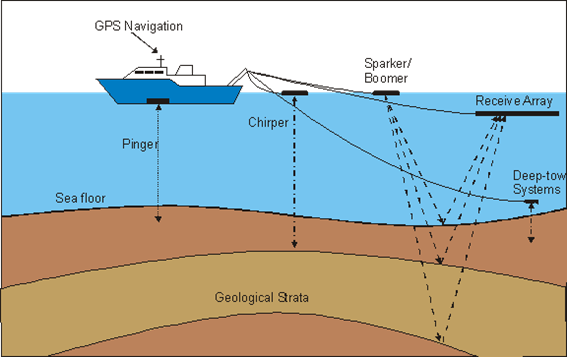
SBP surveys can be performed simultaneously with bathymetry surveys. Figure above shows SBP Measurement method for Pinger type, Chirper type, and Boomer type. Ships equipped with this tool will move in accordance with predetermined lanes. The data generated from the SBP is susceptible to disturbance due to ship engine vibration so that the mounting of the equipment should be far from the engine of the ship.
www.ozcoasts.gov.au
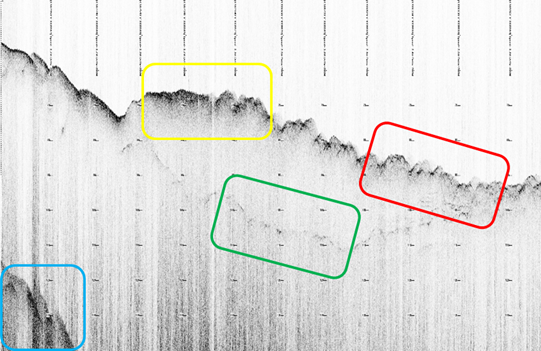
The yellow rectangle in the SBP result cross section is a rock with a finer sedimentary rock size. The red rectangle shows rocks with rough seabed surfaces, resulting in wave diffraction. The green rectangle is interpreted as the sand sediment boundary that is the target of this work. Blue rectangle is noise (ghosting).