

Before carrying out building construction, it is necessary to carry out a soil investigation test measurement. This test is useful to determine the physical properties, thickness, and depth of hard rock as a building foundation design to be made. Several tests can be carried out, such as the Standard Penetration Test (SPT) and the Cone Penetration Test (CPT). Other ground investigation tests such as downhole seismic can also be carried out as additional reinforcement data. This article will discuss downhole seismic testing conducted at Cilegon.
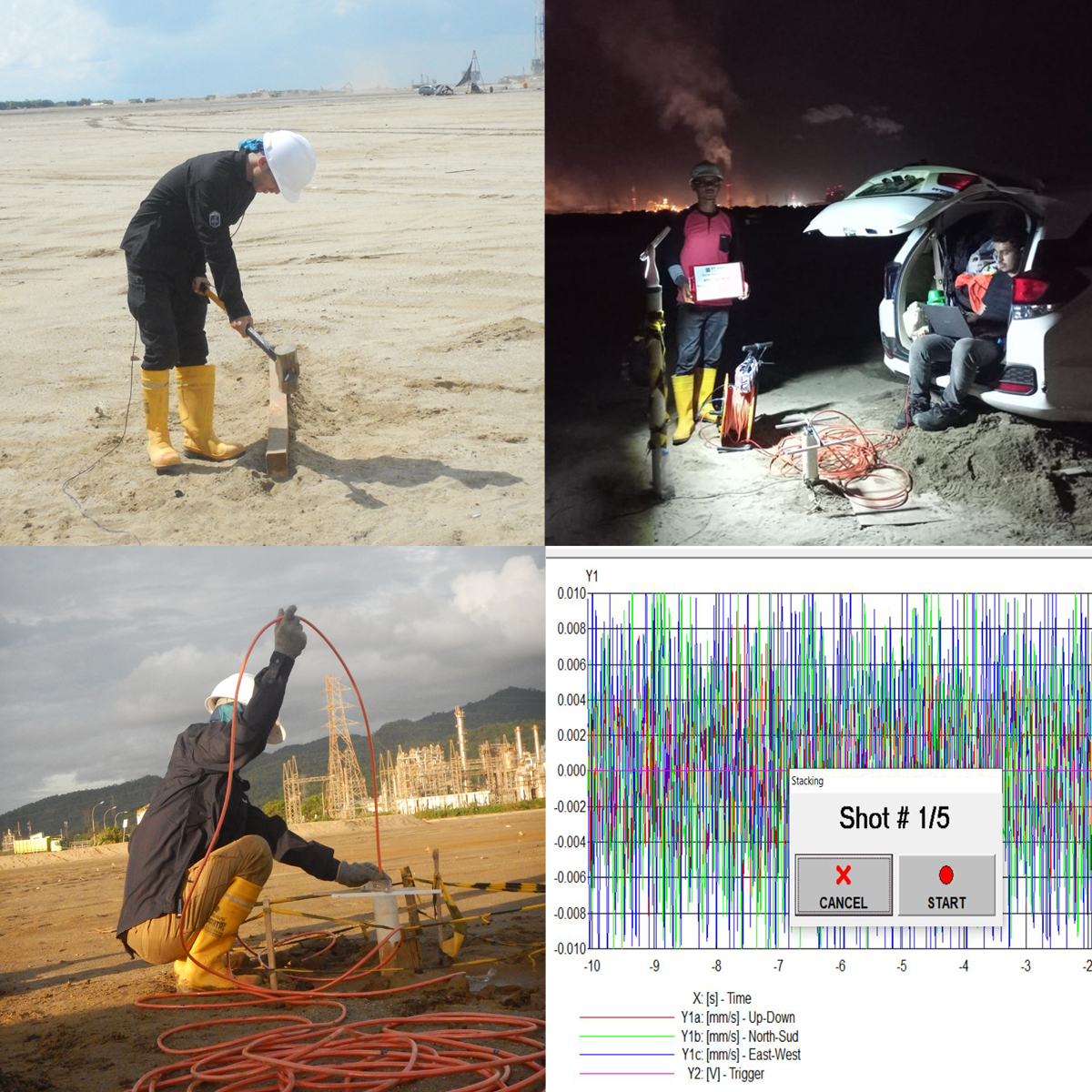
Downhole seismic is one of the geophysical methods to gain information on wave velocity in subsurface rocks, intending to obtain rock physical parameters that affect wave propagation. The purpose of the Seismic Downhole Survey is to obtain a physical property profile of the subsurface layer based on the P-wave (Vp) and S-wave (Vs) propagation from the downhole seismic test (DH). Seismic waves (P-wave and S-wave) are elastic waves that propagate to all parts of the earth's layers and through the earth's surface due to layers composed of materials and densities of different types. Downhole seismic method (DH) measures the time taken for the P and S waves to move between a seismic source located on the surface of the ground, and the receivers, placed inside a borehole.
A triaxial or tridimensional geophone moved down into a borehole connected with a seismograph. Downhole seismic method produces output in the form of reading or interpreting the structure of the earth's subsurface in the form of soil and rock properties by utilizing direct seismic waves. Based on the relationship between velocity and depth, the layer structure and the type of material that make up each layer will be known. Rock properties from downhole seismic surveys are in the form of rocks elasticity constants or Near-Surface Soil Geotechnical Properties.
Rock properties from downhole seismic surveys in the form of material elasticity constants, in this case are rocks such as bulk modulus, shear or rigidity modulus, young's modulus, and Poisson ratio. Bulk modulus (k) is the ability of a material when given a pressure difference so that the object changes in volume. Shear modulus (𝜇) or rigidity is the ability of a material or material when given a force that is perpendicular to the face of the plane (sliding). While the Poisson ratio (𝜗) is the ratio of the transverse strain to the longitudinal strain.