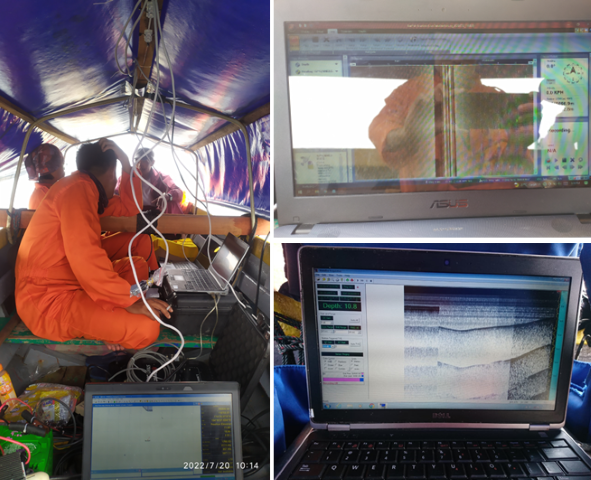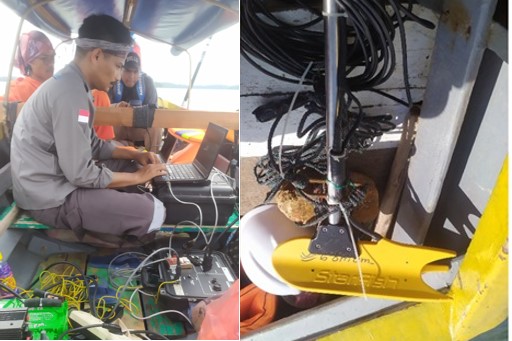
The Duriangkang Reservoir is the largest freshwater reservoir and a vital asset on Batam Island. Examination and investigation of current conditions in the reservoir is very important to do. The basic geometry of the reservoir bottom surface, the height of the water column, and various kinds of features that exist and occur in the water column as well as the reservoir bottom which are not visible from the surface need to be known in detail. This is what underlies the hydrographic survey activities consisting of Sub Bottom Profiling and Side Scan Sonar in the Duriangkang Reservoir.
The Hydrographic Survey at the Duriangkang Dam Reservoir in Batam that has been conducted by Prihaditama as an expert consultant in Geoscience Survey which is based on reliable technology and science, applies the Sub Bottom Profiler (SBP) and Side Scan Sonar (SSS) methods. SBP and SSS are scientific applications of geophysics and geology that are utilized in hydrographic applications. The SBP survey aims to obtain subsurface images from the bottom of the Duriangkang Reservoir, while the SSS aims to obtain images of objects on the bottom surface of the Duriangkang Reservoir.

Data from the SBP survey which describes the pattern of reflection of acoustic waves on rocks based on Snell's Law regarding the nature of wave reflection at areas of rock bedding that have a certain geometry and structure. SBP Survey provides a profile of sedimentary and rock layers under the riverbed/seabed and provides information about the thickness of the sediment and its stratigraphy (isopach), in the form of a lateral distribution profile of the bottom sediment layer and a vertical profile in the form of a rock layer thickness below the seabed surface up to 40 m depth, and SSS Survey provides a profile of detailed object at bottom surface.
SSS system is a sensing strategy to record the condition of the seabed by utilizing the nature of the seabed media which is capable of emitting, reflecting and/or absorbing sound waves. The sound waves used in SSS technology usually have a frequency between 100 and 500 KHz.